
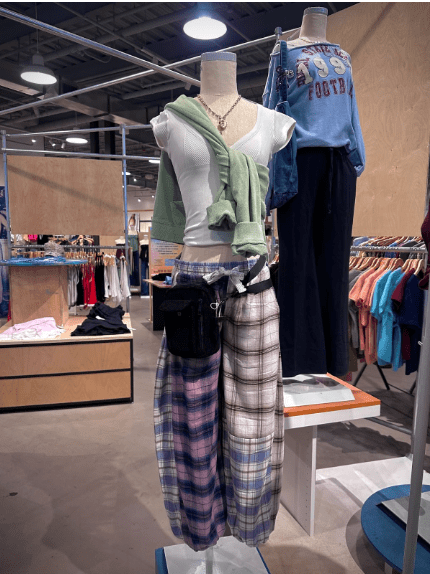
Loose threads, scratchy fabric and see-through material are running rampant in today’s fashion.
However, are college students falling into the trap? What is now considered “fashionable”?
“Minisculinity is always better,” Nali McMillian, 22-year-old senior at State University at UAlbany said. “Less is more, more is less. If you’re the star of the show, you wear less. It gives c**t.”
Even walking from class to class, clothes show others a first impression of one’s personality. That impression is always important, and the way students’ dress to go to their 8 am course may have shifted over the past few years.
“I would say it’s basic now,” 18-year-old La’Vaye Rivera says, a thoughtful expression adorned on the incoming freshman’s face. “Two-piece sets, flare leggings, and anything camo or western themed because that’s what’s trending.”
Retail media networks are causing a surge in consumer data collection, driving revenue through utilizing analytics and brand partnerships. According to Forbes, “‘synthesizing and harmonizing data on consumer trends, shopping behavior, and where things are shifting, will lead to an understanding of how marketers and retailers should adapt to the challenges that they might be seeing,’ explains Dan Bonert, head of retail media in North America, for NielsenIQ.” In large retail shops such as H&M, Hollister, and Urban Outfitters, these novelty “trends” influenced by social media statistics pose the least amount of challenge for mass consumption. Some of these trends for this fall include muted color, western glam and horses, and cowboy boots on anything and everything. Knit and polyester cardigans embroidered with bows stake a claim at every store’s crevice; and any animal one could think of is plastered all over pants, crew necks and hoodies.
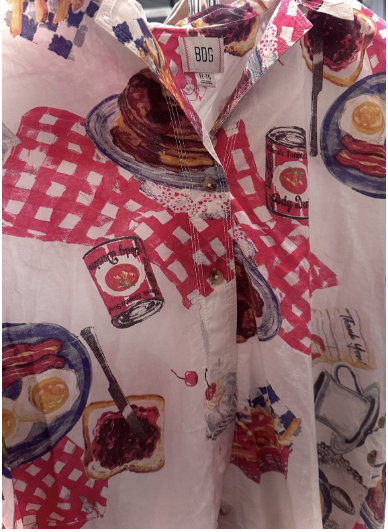
In men’s sections specifically, the clothes have vague sayings and lettering. Jackets are layered with faux fur and polyester, paired on mannequins with oversized, pre-faded jeans. Many of these businesses have resorted to following the same exact trends, and it’s affecting the way we as consumers are dressing as a collective.
There’s clearly no originality in mass production and design.
Oftentimes, a consumer may pick up a fall item and love the item at first glance. But when you look closer: why does everything have to have a cringey saying, weird embroidery or pre-distress?
Ah, the Forever 21 curse strikes again.
“There’s not enough color, glam or variety,” McMillian expresses, as a manager at a local boutique herself. “Color will never go out of season. It’s like — can we not try?”
The way McMillian expresses herself is often through her clothes. She is often working in an environment where customers look at the employees as inspiration for their own individual style. McMillian expresses often how even though it is all “fast” fall fashion, she would wear most things because it’s like hopping on a trend.
“As a society I think we’ve lost the plot,” Rivera laughs, tossing her pink hair back. “But as an individual, no. Fashion has become more individualized, but I can’t truly be that different if everything in the stores are the same things. I don’t just think it is – it is fast fashion.”
In parallel to McMillian, Rivera discusses how important her outfits have become going into adulthood to showcase who she is at the core. However, the way she expresses herself is often through the color of her hair and style. Her jewelry and nails coincide with the color of her shoes, and her crop tops match her baggier pants. Similar to Rivera’s statement about ‘losing the plot’, 2025 fall fashion has shifted into novelty gimmicks, but the individuals that buy these items are sometimes able to make it their own.
“That jacket, I got one kinda like that, but it’s Ralph Lauren,” Simeon Bien-Aime, 30-year-old recent UAlbany school psychology graduate said. “But they both look like they’re made out of the same material. However, it looks cheaper because it doesn’t have a logo on the front. I know a lot of these things are made in the same factories – they’re just putting different labels on them.”

Just like Bien-Aime has been practicing over the years, one should be more mindful going into the fall season thinking that “fast fashion” should be the norm. These chunky, gold painted necklaces and earrings often don’t last forever without rusting and greening away, and that paisley neck scarf
will only stay in trend for so long.
Many of these garments are cheaply produced and ordered in large quantities to stores. This allows the consumer a variety of styling options that follow the latest trends. After the fad is over however, these companies dispose of items that aren’t sold. This disparaged material then ends up in landfills, contributing to pollution. Companies in the past such as Zara utilized mass-producing products with low costs, resorting to importing their materials from countries where human rights within important labor laws are often put on a back burner.
“If I could thrift more, I would.” Rivera says, a solemn expression on. “[Fast fashion] is bad for child labor, the environment and takes away from small businesses.”
These large companies will find any outlet to keep up with rapid production and distribution in the U.S. if it means they can make a quick coin.
According to Earth.org, “the {fast-fashion} industry dries up water sources and pollutes rivers and streams, while 85% of all textiles go to dumps each year. Even washing clothes releases 500,000 tons of microfibres into the ocean each year, the equivalent of 50 billion plastic bottles.”

“I think it’s terrible for the environment and economy,” Bien-Aime said. “The quality of clothes is that you can wear things once or twice before they’re ruined. Back in the day, you could buy an article of clothing and it would last you a few years.”
Similar to a common minimalist trend for the fall, Bien-Aime expresses his individual style by wearing casual clothing, with minimal color such as cream t-shirts and solid cargos, finishing his outfits off with air force ones and a lightweight NorthFace jacket easily accessible to attend his classes and job. He describes modern day fall men’s fashion as bomber and denim jackets, nike techs, adidas gazelle sneakers and nude color New Balances continuing to rise in popularity.
In comparison to newer platforms and stores, older brand names such as Levi Strauss, Eddie Bauer, Ralph Lauren, Carhartt and more have lasted ages among the rapid growth of online fast-fashion platforms such as Shein, Romwe, Fashion Nova, and Pretty Little Thing. One of the biggest issues in new age fall fashion is that consumers often are buying items from these sites for the advantage of the brand name, the easy convenience, and/or the price point; not even thinking about the sustainability aspect alongside the purchase.
“Some hoodies can range from 100 to 175 dollars, and they probably cost 20 dollars to make or less. They’re making a hell of a lot of money for the little cost they put into the product,” Rivera says, annoyed. “Now that’s fast-fashion.”
After viewing many stores and online options available to the public, the newest fall trend can be summed up as fast-fashion pushed by over-consumerism. Even though it’s not a new collective trend for consumers to indulge in filling up their closets, fast-fashion consumption is 400% more than the consumption twenty years ago. According to Earth.org, 80 billion new pieces are produced every year. While we cannot control a large contribution, we can control how much we give in to the new fall fashion trends.
“I see a lot of super baggy clothes and chains on jeans with certain things coming back now,” Simeon Bien-Aime said, a peculiar look forming. “As a society, we’re mainly following trends. I mean, I see people wearing these ugly things now. ”
I mean, he does have a point.
Do you really need that see-through grey-crop with a baby gazelle on it?

 all Platts now
Leave a comment